
External vs. Internal Medical Power Supplies: Thermal Management, Reliability, and Maintenance Costs
Overview
- ■ Structural Differences Between External and Internal Medical Power Supplies
- ■ Thermal Management: How Does Power Configuration Affect Heat Dissipation in Medical Devices?
- ■ Reliability: How to Evaluate Power Supply Stability During Long-Term Operation?
- ■ Maintenance Costs: Evaluating Power Architecture from the Device Lifecycle Perspective
- ■ How to Choose Between External and Internal Medical Power Supplies
- ■ EDAC POWER Offers Diverse Medical Power Supply Solutions
- ■ Evaluating Power Architecture Early in Product Design to Balance Performance, Reliability, and Maintenance Needs
During the development of medical equipment, the power supply is not only a component that provides the electrical power required by the device. Its configuration may also affect the overall mechanical design, thermal conditions, long-term operational stability, and subsequent maintenance methods of the equipment.
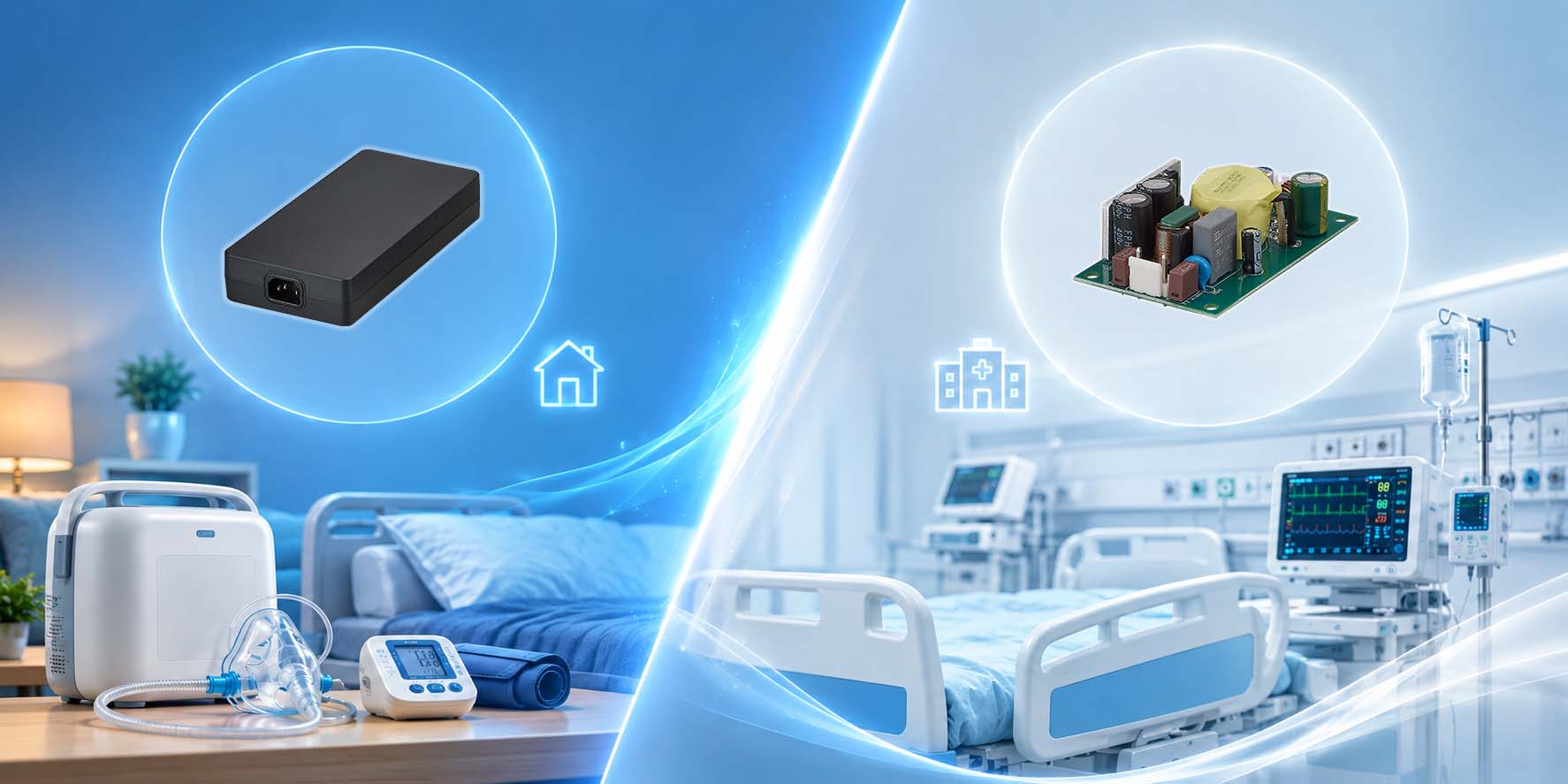
For medical equipment, common power supply configurations can be divided into external medical power supplies and internal medical power supplies. Both architectures have different design characteristics, and their applicable scenarios may be influenced by factors such as device power requirements, mechanical space, operating environment, and maintenance needs.
Therefore, during the early stage of product development, in addition to comparing output power, dimensions, efficiency, and safety compliance requirements (such as IEC 60601-1 and 2xMOPP isolation), power architectures can also be evaluated from the perspectives of thermal management, reliability, and maintenance costs as a reference for overall system design.
Structural Differences Between External and Internal Medical Power Supplies
External medical power supplies place the power conversion function outside the main device and provide power through output cables. Internal medical power supplies integrate the power module inside the device housing, with power conversion performed within the equipment. Each architecture has different design considerations.
External Medical Power Supplies
Since the power module is located outside the main device, an external architecture can generally provide greater flexibility in mechanical configuration, for example:
- Heat generated during power conversion can be separated from electronic components inside the main device.
- The space required for power supply and heat dissipation inside the main device can be reduced.
- The power supply module can be replaced relatively independently from the main device.
- It can support lightweight or compact designs for certain devices.
- Different power supply solutions with various output specifications can be selected according to product requirements.
This type of architecture is commonly used in desktop, portable, home healthcare, and other devices that require greater configuration flexibility.
Internal Medical Power Supplies
Internal medical power supplies integrate the power module directly into the device housing. Common design considerations include:
- High integration between the power supply and the device, which supports an integrated product design.
- User-side cable management can be simplified, potentially improving the product user experience.
- Configuration can be based on the device's power requirements and available internal space.
- It can provide design flexibility for stationary equipment or certain high-power applications.
When the power supply is installed inside the equipment, the heat generated during power conversion directly enters the internal thermal environment. Therefore, thermal management generally needs to be considered together with the overall mechanical design.
Thermal Management: How Does Power Configuration Affect Heat Dissipation in Medical Devices?
As medical devices move toward smaller form factors, higher integration, and lower noise levels, some devices may adopt fanless or relatively enclosed mechanical designs. While such designs can help meet specific product requirements, they may also limit heat dissipation paths inside the equipment. Under these conditions, the location and cooling method of the power supply can become an important consideration in the overall thermal design of the product.
External Medical Power Supplies: Separating the Power Heat Source from the Main Device
One design characteristic of an external medical power supply is isolating the primary power conversion heat outside the main chassis. For fanless medical devices constrained by strict enclosure touch temperature limits, this architecture effectively.
- Reduce the heat source density inside the main device.
- Reduce the impact of power supply heat on other electronic components.
- Simplify the internal heat dissipation configuration of the device.
- Reduce the need for additional heat dissipation space in certain products.
For devices featuring fanless designs, limited mechanical space, or temperature-sensitive internal components, these factors are worth considering during the product design evaluation stage.
It is worth noting that an external architecture does not mean that the power supply itself does not require thermal management. The power supply still requires appropriate heat dissipation design based on load conditions, ambient temperature, ventilation conditions, and product specifications.
Internal Medical Power Supplies: Integrating Thermal Management into the Overall Device Design
When the power supply is located inside the equipment, the heat generated by the power supply directly enters the internal thermal environment. Therefore, the design team generally needs to evaluate the following factors together:
- Power supply efficiency and thermal losses
- Power component layout and configuration
- Selection of heat sinks and thermal interface materials
- Housing materials and thermal conduction paths
- Natural convection or forced cooling conditions
- Internal hotspot distribution
- Worst-case ambient temperatures and long-term operating conditions
Especially in enclosed or fanless devices, whether heat can be effectively conducted to the housing and dissipated may directly affect the operating temperature of internal components. Although power supply efficiency is an important factor in reducing thermal losses, it is still recommended to evaluate it together with whole-device thermal simulations and actual testing. The actual operating temperature of the same power module may vary under different mechanical structures, ambient temperatures, and load conditions.
Reliability: How to Evaluate Power Supply Stability During Long-Term Operation?
The reliability of a power supply in medical equipment is closely related to the actual operating environment and operating conditions, in addition to whether the power supply can provide stable output. Prolonged high-load operation, higher ambient temperatures, or restricted heat dissipation conditions may cause internal power components to remain at relatively high operating temperatures for extended periods. The operating temperatures of certain power components, such as electrolytic capacitors and power semiconductors, are related to long-term reliability. Therefore, appropriately controlling operating temperature is an important aspect of reliability design.
External Medical Power Supplies: Helping Reduce the Thermal Load Inside the Main Device
By keeping power heat outside the main chassis, external adapters minimize ambient temperature rise around sensitive internal components like electrolytic capacitors. For 24/7 operating medical equipment, this reduction in internal thermal stress directly supports prolonged system lifespan and derating safety margins.
Internal Medical Power Supplies: Reliability Closely Related to Overall Thermal Design
Internal medical power supplies can also achieve the reliability level required by the product through appropriate component selection, derating design, heat dissipation configuration, and temperature control. During the early stage of product design, particular attention can be given to the positional relationship between the power supply and other heat-generating components, as well as whether heat can be effectively conducted to the exterior of the equipment. Thermal simulations, temperature rise testing, and long-term operation testing can help provide an understanding of temperature distribution under actual operating conditions and serve as a reference for subsequent design adjustments.
The selection of power supply architecture does not have a single cause-and-effect relationship with reliability. Whether an external or internal architecture is selected, actual reliability needs to be evaluated within the context of the overall equipment design rather than judged solely by the configuration method.
Maintenance Costs: Evaluating Power Architecture from the Device Lifecycle Perspective
For medical equipment manufacturers, the cost of a power supply is not limited to the initial purchase price. From the perspective of the device lifecycle, the following questions are worth considering during the development stage:
- Is the power module easy to replace?
- Does maintenance require disassembling the entire device?
- How much time is required for maintenance personnel to complete a replacement?
- Is it necessary to prepare separate spare parts?
- What impact could equipment downtime have?
- Could different power supply architectures affect after-sales service processes?
These factors can also help provide a more comprehensive evaluation of the actual lifecycle costs of the equipment.
External Medical Power Supplies: Maintenance and Replacement May Be More Direct
If an external medical power supply adapter fails, the power supply module can generally be handled separately from the main device. In certain application scenarios, this may help:
- Shorten the replacement time of the power supply module.
- Reduce the need to disassemble the main device.
- Reduce the complexity of on-site maintenance.
- Facilitate independent management of spare power supplies.
- Increase flexibility in equipment maintenance.
For products distributed across a wide range of locations or requiring maintenance in different settings, such as medical institutions and home healthcare environments, these factors can be considered as part of the overall service strategy.
Internal Medical Power Supplies: High Integration May Also Bring Different Maintenance Considerations
Internal medical power supplies can provide a higher degree of equipment integration. However, if the power supply fails, maintenance may require the device housing to be disassembled first. The actual maintenance process may involve:
- Device disassembly
- Removal of the power supply module and wiring
- Component replacement
- Insulation and safety verification
- Reassembly and functional testing
Considering maintenance space, modularity, and component serviceability during the device development stage can help with subsequent maintenance planning. For medical equipment deployed over the long term, these design considerations may provide a more comprehensive view of actual lifecycle costs than simply comparing power supply procurement prices.
★ Related Article:
Medical Power Supply Thermal Management: How Heat Affects Reliability and Lifespan
How to Choose Between External and Internal Medical Power Supplies?
There is no single answer applicable to all medical equipment when choosing between external and internal power supplies. The actual selection should be evaluated based on device power requirements, mechanical design, operating environment, thermal conditions, and maintenance strategies.
| Evaluation Item | External Medical Power Supplies | Internal Medical Power Supplies |
|---|---|---|
| Power Configuration | Power module is located outside the main device | Power module is integrated inside the device |
| Thermal Management | The primary power heat source can be separated from the main device | Power supply heat needs to be incorporated into the overall thermal design |
| Device Space | Reduces the space required for power supply configuration inside the main device | Requires space for the power supply and heat dissipation |
| Device Integration | Power supply and main device are relatively independent | Power supply and device are highly integrated |
| Maintenance Method | Power supply module can be handled relatively independently | Maintenance processes need to be planned together with the mechanical design |
| Spare Parts Management | Power supply spares can be managed independently | Usually integrated with the overall equipment maintenance process |
| Exterior Design | External power supply and cable configuration need to be considered | Supports an integrated, all-in-one device design |
| Applicable Scenarios | Portable, desktop, home healthcare, and other applications requiring flexibility | Stationary equipment or devices requiring a high degree of integration |
※ Practical Note: The above comparison reflects general design considerations. Actual power architecture selection should still be evaluated based on device specifications, operating modes, mechanical design, environmental conditions, and relevant safety standards.
EDAC POWER Offers Diverse Medical Power Supply Solutions
Different medical devices have different power requirements, mechanical constraints, and operating environments. Therefore, power architectures also need to be evaluated according to product conditions. EDAC POWER provides diverse medical power supply solutions, covering both external medical power supplies and internal medical power supplies, to meet the design requirements of different medical equipment.
During the product development stage, power supply selection involves not only output power and electrical specifications, but also the evaluation of thermal management, reliability, mechanical integration, and maintenance needs. Conducting an overall evaluation at an early stage can help reduce design adjustments related to power configuration during later stages of product development. Based on customer product requirements, EDAC POWER provides technical support in areas including power specifications, thermal management, and system integration to assist product development teams in evaluating suitable power supply architectures.
Evaluating Power Architecture Early in Product Design to Balance Performance, Reliability, and Maintenance Needs
Power supply design is not simply a matter of “how much power to provide.
The comparison between external and internal medical power supplies shows that power configuration may interact with the thermal management, long-term reliability, and subsequent maintenance of the equipment.
Therefore, during the early stage of product development, three factors can be included in the overall evaluation: thermal management, reliability, and maintenance costs.
For certain equipment, external medical power supplies may help reduce the internal thermal load of the main device and simplify subsequent replacement. For other equipment requiring a high degree of integration, internal medical power supplies may better meet mechanical and product design requirements. The appropriate solution still depends on the device's power requirements, operating environment, mechanical conditions, and lifecycle planning.
If you are evaluating external and internal medical power supply applications, please contact the EDAC POWER technical team. We will assist you in evaluating a suitable power supply architecture and provide relevant technical support and medical power solutions based on your product requirements.