
USB-C PD for Medical Devices: Applications, Challenges, and Power Design Guide
Overview
- ■ A New Design Perspective: USB-C PD in Medical Devices
- ■ Where USB-C PD Makes Sense: Suitable Medical Applications
- ■ Where USB-C PD Falls Short: Scenarios to Avoid
- ■ Key Evaluation Criteria: Power Demand and System Stability
- ■ How EDAC POWER Provides Diverse and Stable Medical Power Solutions
- ■ Choosing the Optimal Medical Power Architecture: Balancing Innovation and Stability
As USB-C interfaces become ubiquitous in consumer electronics, discussions surrounding "power standardization" and "unified connection interfaces" are gaining momentum in the medical device market. With its compact connector design, flexible multi-voltage output, and cross-device compatibility, USB Power Delivery (USB-C PD) has emerged as a popular power option for many portable and lightweight medical devices.
However, the cornerstone of medical device power design remains "patient safety" and "system operational stability." While USB-C PD offers immense convenience, it is not suitable for every medical scenario or equipment type. During the early product development stage, engineering and procurement teams must carefully evaluate actual power demands, connection stability, and environmental rigor to strike an appropriate balance between user experience and system reliability.
A New Design Perspective: USB-C PD in Medical Devices
The maturity of USB-C PD technology offers medical device designers greater architectural flexibility. Traditional medical equipment has historically relied on dedicated power adapters or customized connectors; while this maintains specification exclusivity, it increases the complexity of spare parts management and field cabling configuration. Key advantages of adopting USB-C PD include:
- Broad Interface Compatibility: Simplifies cable management in healthcare facilities and nursing environments, reducing inventory pressure for spare adapters.
- High Design Flexibility: Supports multiple voltage/current combinations (e.g., 5V, 9V, 15V, 20V, 28V, etc.) to satisfy power requirements for various functional modules.
- Compact and Convenient: Ideal for devices prioritizing lightweight design, portability, or home healthcare applications.
Where USB-C PD Makes Sense: Suitable Medical Applications
USB-C PD delivers substantial integration benefits when equipment exhibits low-to-medium power requirements, high mobility, or is intended for home care.
1. Home Healthcare and Personal Diagnostic Devices:
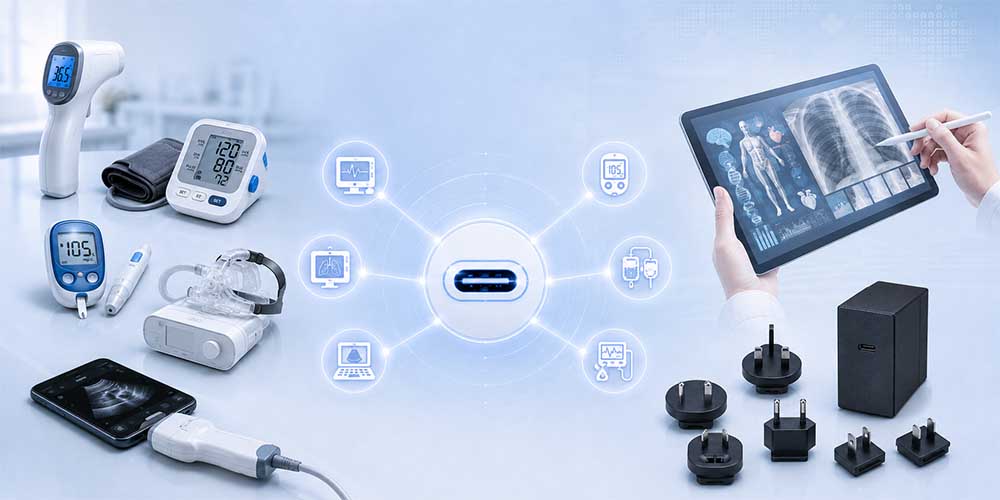
Examples include infrared forehead thermometers, electronic blood pressure monitors, handheld blood glucose meters, and charging docks for home Continuous Positive Airway Pressure (CPAP) devices. Operating power for these devices typically ranges from 10W to 65W in residential environments, where the convenience of USB-C significantly enhances the product experience.
2. Portable and Handheld Diagnostic Tools:
Examples include handheld ultrasound probes, mobile otoscopes, or ophthalmoscopes. These devices require frequent movement by healthcare personnel and often feature internal batteries; utilizing USB-C for intermittent charging or low-power supply fits seamlessly into clinical workflows. In many such designs, USB-C PD is particularly well suited for battery charging or supplemental power input rather than as the sole primary power source.
3. Non-Life-Critical Auxiliary Equipment:
Tablet PCs on mobile nursing carts, clinic examination lights, or vital sign recorders used by medical staff for non-emergency diagnostic assistance.
Where USB-C PD Falls Short: Scenarios to Avoid
Despite its advantages, the technical characteristics of USB-C PD can become potential system stability risks in high-power, high-risk medical, or harsh environments.
1. High-Power Continuous Operation Equipment:
Although the latest USB PD 3.1 specification theoretically supports up to 240W output, prolonged high-load operation can cause thin USB-C plugs and cables to generate higher temperatures, potentially triggering thermal derating or system protection mechanisms. In addition, long operating hours and connector wear should also be considered in continuous-use medical systems. For high-power medical imaging equipment or advanced laboratory analyzers, adopting professional Open Frame Power Supplies or high-power embedded power units is generally a more robust choice.
2. Life-Support and Critical Care Equipment:
Patient monitors, ventilators, and infusion pumps demand highly reliable continuous power delivery. USB-C utilizes a friction-fit insertion structure without an active locking mechanism, making cables vulnerable to accidental disconnection if pulled during emergency care or ward nursing. Furthermore, USB-C PD requires voltage negotiation via a handshake protocol upon initial connection; if affected by strong electromagnetic interference (EMI), the reliability of power delivery should also be carefully evaluated.
3. Environments Requiring Frequent Disinfection or Harsh Protection:
Medical settings require frequent wipe-downs with alcohol or disinfectants. Attention must be paid to the cleaning and insulation protection of delicate internal pins inside USB-C sockets, as long-term pin corrosion or dust accumulation may increase maintenance difficulty and short-circuit risks.
★Related Article:
Key Evaluation Criteria: Power Demand and System Stability
| Evaluation Item | USB-C PD Solution | Traditional External / Open Frame Medical Power Supply |
|---|---|---|
| Applicable Power Range | Recommended under 100W (Light/Medium load) | Covers a few watts to several kilowatts (High power/current demand) |
| Connection Security | Friction-fit; relatively higher disconnection risk | Equipped with screw locking, terminal blocks, or latching mechanisms |
| Power Negotiation | Requires protocol handshake via PD IC | Fixed physical output; immediate power-on without negotiation delay |
| Safety Isolation | Requires system-level design to comply with IEC 60601-1 | Product directly complies with 2xMOPP high medical insulation standards |
| Environmental Tolerance | Fine connector pins; difficult maintenance and IP sealing | Robust mechanical enclosure; withstands harsh cleaning and thermal extremes |
※ Practical Recommendation: If device power consumption exceeds 100W, or involves patient life safety and high-precision signal measurement, evaluating dedicated medical-grade external power adapters or open frame power supplies is recommended to maintain appropriate electrical isolation and operational stability. The 100W threshold should be viewed as a practical design reference, and the final decision should still depend on duty cycle, thermal conditions, connector reliability, and regulatory requirements.
How EDAC POWER Provides Diverse and Stable Medical Power Solutions
Whether your medical product is planning to adopt a flexible USB-C PD architecture or requires high-power, ultra-stable open frame and external medical power supplies meeting 2xMOPP isolation standards, EDAC POWER offers a comprehensive product line complying with international medical safety standards (IEC 60601-1).
Our engineering team possesses extensive experience in medical power supply development. We can assist you during early-stage product design in evaluating optimal power architectures, thermal management layouts, and electromagnetic compatibility (EMC) configurations—helping you reduce development risks and accelerate product certification and time-to-market.
Choosing the Optimal Medical Power Architecture: Balancing Innovation and Stability
As medical equipment evolves toward intelligence, portability, and high performance, the choice of power system directly impacts product safety and user experience. USB-C PD provides excellent convenience and versatility for low-to-medium-power medical devices, especially portable and handheld diagnostic equipment; meanwhile, for high-power, continuous operation, and critical care scenarios, dedicated medical-grade power adapters and open frame power supplies remain the foundation to maintaining system reliability.
If you are evaluating power solutions for your next-generation medical devices, please contact the EDAC POWER technical team. We will assist you in selecting the most suitable power architecture, providing comprehensive technical support and high-quality power solutions for your products.